Gauss’s law is usually written
where is the permittivity of vacuum. and is the net charge of the enclosed surface
The circle integral symbol (), btw, is just an integral over a closed contour (which is topologically a circle). Par example:
Thus the integral in Gauss’s law should be evaluated over a closed loop. In the integral for Gauss’s law, the vector represents an infinitesimal surface element. The magnitude of is the area of the surface element. The direction of is normal to the surface element, pointing out of the enclosed volume.
The total electric flux through a closed surface depends only on the enclosed charge, not on the size or area of the surface. So, even if surface A has an area twice as large as surface B, as long as the same charge is enclosed within both surfaces, the total electric flux will be the same.
When a solid conducting sphere is placed in an external uniform electric field, there is no electric field on the interior of the conducting sphere. This is because the free charges within the conductor rearrange themselves in response to the external field. This is because:
- In electrostatic equilibrium, the electric field inside a consider must be zero because if it contained a non-zero electric field the free charges would move— so not an electrostatic equilibrium
- The charges on the surface of the conducting sphere rearrange in such a way as to cancel out the external electric field within the conducting material itself. This creates an opposite field on the inside that exactly cancels the applied external field in the interior.
- Effect on the exterior field: The conducting sphere will still interact with the external electric field, and the charge redistribution on the surface of the sphere may create a distorted field outside the sphere. However, this does not affect the fact that the interior electric field is zero.
Conductor
A conductor is a material where free charges (electrons) are able to move around. Without an external electric field or disturbances, they distribute themselves in a way that the system is in electrostatic equilibrium. This means:
- The electric field inside the conductor is zero. Since charges are free to move, if there were any field inside the conductor the charges would experience a force and move to counteract it. (Not inside cavities, but in the conductor itself)
- The charges on the conductor reside entirely on the surface. If there were charges in the interior they would feel.a force and move towards the surface.
When a charge is placed inside the cavity of a conducting spherical shell, the charge inside the cavity does not affect the conducting material directly. However, the charge inside the cavity incudes a charge on the inner surface of the conductor. This is equal in magnitude but opposite in sign to the charge inside the cavity and is needed to cancel the electric field from the charge inside. The outside must adjust in response, .
Questions
Problem 4
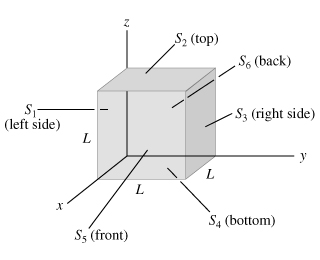
The cube (see above) in has sides of length . The electric field is uniform, has a magnitude , and is parallel to the -plane at an angle of measured from the -axis toward the -axis.
What is the electric flux through the cube face in
Where is the angle between the electric field and the normal to the surface.
For , the normal vector points in the direction, because
- For flux calculations, we measure the angle from the normal vector TO the electric field vector
- The normal vector to points in the direction, which is at in the -plane
- The electric field is at in the -plane
- Therefore, to get from the normal vector to the electric field vector, we need to rotate through
Thus .
We can also derive, for this, that:
And thus
And for the total electric flux,
Problem 5
A square insulating sheet on a side is held horizontally. The sheet has of charge spread uniformly over its area. a) Estimate the magnitude of the electric field at a point above the center of the sheet. b) Estimate the magnitude of the electric field at a point above the center of the sheet.
For an infinite charged sheet, the electric field is constant and given by , where represents the surface charge density.
To approximate the distance close by we can pretend its an infinite sheet:
For the further away distance, let’s treat it as a point charge
If both sheets were made of a conducting material, the charge would automatically spread out evenly over both faces, giving it half the charge density on either face as the insulator but the same electric field. Far away, they both look like points with the same charge. Neither answer would change.
Problem 6
As a honeybee flies, the passing air strips electrons from its hairs, giving the bee a net positive charge. Since flowers are negatively charged, pollen then jumps onto a bee even if the bee does not physically touch the pollen particles. We estimate the diameter of the central disk of a daisy as .
If a bee has had 75,000 electrons stripped by the air, what is its net charge?
If this bee lands at the edge of the daisy’s central disk, determine its electric field () at the far edge of the disk. Treat the bee as a thin-walled hollow sphere with its net charge distributed uniformly over its surface.
A pollen particle requires a force of 10 to dislodge from a stamen. Estimate the net charge () on a pollen particle at the far end of the disk required for the particle to dislodge and jump to the bee. ()
Problem 7
A hollow, conducting sphere with an outer radius of and an inner radius of has a uniform surface charge density of . A charge of is now introduced into the cavity inside the sphere.
a) What is the new charge density () on the outside of the sphere?
Recall that for a conducting sphere, any excess charge resides on the outer surface. When we introduce a charge inside the cavity, it induces charges on the inner and outer surfaces.
Thus, for the new charge density on the outer surface:
b) Calculate the strength of the electric field () just outside the sphere.
c) What is the electric flux () through a spherical surface in the cavity just inside the inner surface of the sphere?
Problem 8
A sphere of radius carries charge . Calculate the electric-field magnitude at a distance from the center of the sphere and at a distance from the center of the sphere if the sphere is a solid insulator with the charge spread uniformly throughout its volume.
If the field is an insulator Electric field inside the sphere , given that
Electric field outside the sphere
What if it’s a conductor?
Electric field inside the sphere must be zero, the outside remains the same as it was before.
Alors, infinite line
You place a point charge a distance of from an infinitely long, thin wire that has linear charge density . What is the magnitude of the electric force that the wire exerts on the point charge?
Next, infinite sheet
A point charge is from a thin, flat, infinite sheet that has a uniform surface charge density. If the total electric field is zero at a point halfway between the point charge and the sheet, what is the surface charge density of the sheet?
- The electric field from a point charge is pointing radially outward
- The electric field from an infinite charged sheet is pointing perpendicular to the sheet
- These fields will point in opposite directions for charges of the same sign
Therefore, the surface charge density of the sheet is (positive since it must repel the positive point charge).
Finally, two plates
Two large parallel conducting plates carry charges of equal magnitude and opposite charge. When you place a point charge between the plates, the force on the point charge is . What is the magnitude of the surface charge density on either plate?
Recall that for an infinite charged plate, electric field from a single plate is
For two oppositely charged plates, the fields add, so the total electric field between plates is
1/19/25