SGD
Stochastic Gradient Descent: is the fundamental algorithm for training neural networks, it updates model parameters θ using this rule:
Where:
- = current parameters
- = learning rate at step
- = gradient of loss on batch
- = random batch of training data
It works like this,
- Start with random parameters
- each training step:
- sample a batch of data
- compute how much the loss would change if you nudged each parameter (the gradient)
- move parameters in the opposite direction of the gradient to reduce loss
- repeat 🔁
This is what it looks like in python:
class SGD(torch.optim.Optimizer):
    def __init__(self, params, lr=1e-3):
        # Store parameters and hyperparameters
        super().__init__(params, {"lr": lr})

    def step(self):
        # Update each parameter using gradients
        for group in self.param_groups:
            for p in group["params"]:
                if p.grad is not None:
                    p.data -= group["lr"] * p.grad.data
The Decaying Learning Rate Variant: implements SGD with learning rate decay:
This reduces the learning rate over time, taking smaller steps as training progresses.
Points to Note:
- SGD is “stochastic” because it uses random batches, not the full dataset
- The learning rate controls step size - too large causes instability, too small is slow
- Modern optimizers like AdamW (below) build on SGD’s foundation but add momentum and adaptive learning rates
AdamW
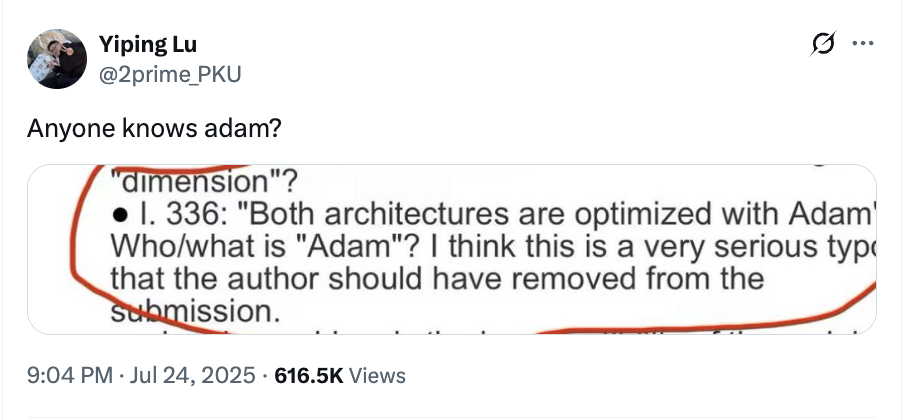 Anyone knows adam?
Adam is a more sophisticated optimizer. It maintains running estimates of both first and second moments of gradients, making it more stable and faster-converging than basic SGD.
m ← β₁m + (1 - β₁)g              # First moment (momentum)
v ← β₂v + (1 - β₂)g²             # Second moment (variance)
αₜ ← α * √(1-(β₂)ᵗ) / (1-(β₁)ᵗ)   # Bias correction
θ ← θ - αₜ * m/√(v+ε)             # Parameter update
θ ← θ - αλθ                      # Weight decay (AdamW's key difference)
9/17/25